Three Years Into the Light Roast Espresso Martini
A working journal from three years of obsessing over foam physics, extraction chemistry, and why light roast is both the most interesting and most punishing ingredient you can use in a cocktail.
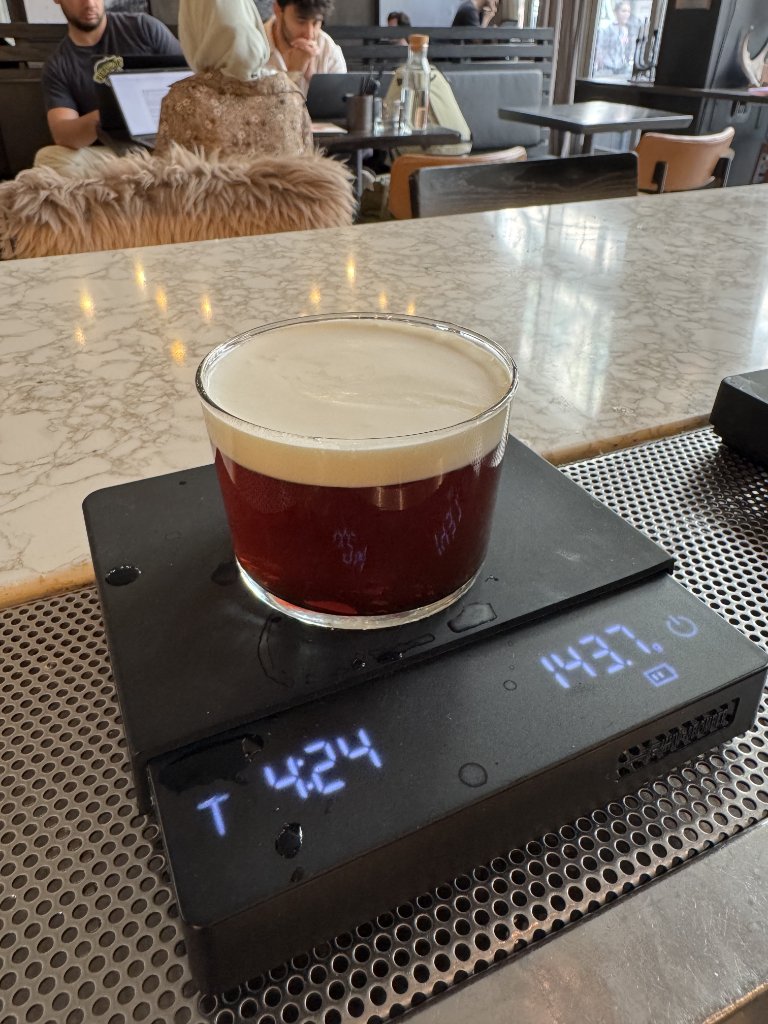
Foam stability gains in a super light roast achieved through paper filtering
The Washed Ethiopian That Started It
The first espresso martini in this project was built with a washed Ethiopian. That specificity matters. It was not a decision made by accident. A washed Ethiopian is a coffee processed by removing all of the fruit from the bean before drying it, which tends to produce a clean, bright cup. This particular one had floral, bergamot forward, stone fruit adjacent character, meaning it tasted like tea roses and plums and citrus peel. It was about as far as you can get from the Kahlua and dark roast baseline most people carry in their heads when they think of an espresso martini. That gap between what the drink typically is and what it could be was obvious from the first sip. The coffee had terroir, which just means it tasted like somewhere specific on earth rather than like coffee in the generic sense. The standard recipe erased almost all of that the second it hit the glass.
That first drink was made with coffee liqueur, freshly pulled espresso, and vodka. It tasted like an espresso martini. It did not taste like that Ethiopian. The coffee's floral top notes, the delicate aromatic qualities that were most interesting about it, dissolved somewhere between the pour and the shake. What arrived in the coupe was sugar and coffee in the abstract, not a specific place, not a specific process, not any of the things that made that bean worth buying. It was a good espresso martini. It was a bad use of a great coffee.
That gap was the beginning of three years of work.
Dropping the Coffee Liqueur
The first real breakthrough was removing coffee liqueur from the recipe entirely. In its place went a coffee syrup made from the same beans used for the espresso shot. The syrup method: brew a pour over directly onto sugar while the water is still hot. The hot brew melts straight into the sugar granules, building a one to one simple syrup in a single step without any additional water. Once the brew is complete, chill it as fast as possible. Rapid chilling locks the aromatic structure in place. Heat is the enemy of those delicate aromatic compounds. Every second the syrup sits warm is time those flavors spend escaping into the air instead of staying in the glass.
The syrup is then lightly acidified to approximately 1% titratable acidity. Titratable acidity is a way of measuring the total acid content in a liquid, and 1% is a relatively gentle level, about equivalent to a mild fruit juice. This is not a dramatic intervention. It is a subtle one. Adding a small, precise amount of acid gently pushes the fruit character of the coffee forward against everything else in the build. The result is a syrup that actually tastes like the coffee it was made from.
The case against coffee liqueur is not complicated. Coffee liqueur is sugar, alcohol, and coffee flavoring. An espresso martini made with coffee liqueur is therefore sugar, alcohol, and espresso, plus more sugar, more alcohol, and more coffee flavoring. You are doubling up on the same categories while actively drowning out what makes your actual coffee interesting. Coffee liqueur is useful in the sense that it provides consistency. The consistency it provides is generic. No matter which brand you use or how good your espresso is, the finished cocktail is going to taste like coffee in the abstract rather than the specific coffee you started with. That is the problem. The entire premise of this project is that light roast coffees have origin specific flavor, flavors tied to where they were grown and how they were processed, things you genuinely cannot find in a bottle. Using coffee liqueur in that context is working directly against the thing that makes the cocktail worth building.
When the liqueur came out and the custom syrup went in for the first time, the difference was jarring. The Ethiopian flavor was suddenly present in a way it had not been before. The floral notes made it into the glass. The fruit character registered. The drink tasted like the coffee it was built around.
Bar Contra and the Science Shift
Working at Bar Contra pushed the approach into a much more scientific mode. Two things became load bearing in how I think about the espresso martini specifically.
The first is how dilution actually works when you shake. When you shake a cocktail, water from melting ice does not enter the drink steadily or evenly. The bulk of the dilution happens in roughly the first five to eight seconds. Ice melts fast when it first contacts warm liquid, a lot of water enters the drink quickly, and then the rate slows dramatically. After that initial burst, additional shaking time stops adding meaningful water to the drink. What it does instead is continue to agitate and aerate the liquid in ways that affect texture and how all the ingredients bond together. For an espresso martini, this is critical information. It means you can shake longer without worrying about drowning the drink in melt water. Shaking for fifteen or twenty seconds instead of ten is not the same as adding more water. The water content stabilizes. The texture does not.
The second is the freezer vodka protocol. The thermal problem in a standard espresso martini build is this: hot espresso hitting cold ice causes rapid, uncontrolled melting before the shake has done any intentional work. That melt water goes into the drink as a form of dilution you never accounted for and cannot control. The fix is simple and strange and it works: store the vodka in the freezer, as cold as possible without freezing solid (around negative 18 degrees Celsius, which also makes the liquid slightly thicker and more viscous). Pull the hot espresso shot and immediately pour the freezer cold vodka over it. The temperature gap between the two is roughly 110 to 115 degrees Celsius. Several things happen simultaneously. The aromatic compounds in the espresso stop escaping into the air because the temperature drops fast. The cold vodka brings the system close to cold before ice is ever introduced. When you add ice and shake, the ice is not entering a hot liquid that will melt it aggressively. It enters a system that is already close to cold. You shake on your terms, not on the ice's terms.
One more thing that took a while to figure out: the order of addition matters. Pour the espresso into the shaker tin first. Then add the cold vodka over it. Do not pour espresso into a vessel that already contains vodka. When hot espresso hits a concentrated pool of alcohol all at once, the delicate aromatic top notes seem to blow off faster than they would with a gentler, reversed pour. Pouring the vodka over the espresso is the softer introduction. It preserves more of the top.
The Barista Chapter
When I started working more seriously as a barista and getting better at dialing espresso, there was an assumption underneath the work: better espresso would mean better espresso martinis. That turned out to be wrong, or at least incomplete in a way that took months to understand.
A technically excellent espresso shot, calibrated for drinking straight, does not automatically make a better cocktail. Espresso dialed for the cup is optimized for a situation where you drink it immediately, alone, without anything else being added to it. The cocktail is not that situation. The espresso enters a system where dilution continues through the syrup, through alcohol contact, and through the shake. A shot that is perfectly balanced on its own often enters the cocktail already at a state of balance that all that additional dilution pushes past. It enters the glass and it just gets thinner.
The useful frame here is bypass brewing. In filter coffee, bypass brewing is when you intentionally brew a smaller, more concentrated volume and then add a predetermined amount of water afterward rather than trying to hit one perfect ratio that does everything at once. You brew strong on purpose, then add controlled water at the end. The idea is that pulling flavor out of coffee behaves differently depending on concentration, and you get cleaner results by brewing tight and diluting deliberately rather than trying to extract everything in one go. In the espresso martini, the espresso plays the role of that concentrated brew. The shake with ice, the syrup, and the spirit are the water addition stage. Everything that happens after the shot enters the tin is the dilution.
A slightly tighter, more concentrated shot that tastes a little sharp and forward on its own can become something genuinely better once cocktail dilution opens it up. The flavors that felt squeezed have room. The fruit notes in a light roast that seemed buried come forward when the whole system dilutes into balance. The calibration process has to happen with the cocktail as the reference point, not the cup. They require different standards and optimizing for one does not automatically serve the other.
This is still being worked through. The exact parameters, dose, how much to extract, and build ratios that work across different light roast coffees are not settled. What is clear is that the evaluation has to happen in context.
Why Light Roast Is Both Worth It and a Problem
Light roast coffees retain origin character that dark roast largely destroys. The longer coffee roasts, the more the heat breaks down and transforms the compounds that give it its specific, place-based flavor. A washed Ethiopian, a Kenyan natural, a Guatemalan honey process: these coffees have flavor profiles tied to where and how they were grown and processed. That specificity is the entire reason to build this cocktail the way it is built. The goal is a drink that actually tastes like a place. Not coffee in the abstract. A specific coffee from a specific origin, present and recognizable in the glass.
The problem is that light roast is structurally harder to work with in an espresso martini than dark roast across almost every dimension that matters for foam and texture. Most of that comes down to one category of compound: melanoidins.
Melanoidins and Why Roast Level Matters
Melanoidins are the brown compounds produced when coffee roasts. They form through a chemical reaction that happens when sugars and proteins meet heat over time, the same family of reactions that make bread crusts brown and steak sear. They are what gives dark roasted coffee its deep color and its full, round texture on the palate.
For an espresso martini, melanoidins matter for one specific reason: they are the primary structural support for foam. They naturally migrate to the surface where air meets liquid and form a kind of flexible, protective skin around each bubble. More melanoidins means more structural support, which means foam that holds longer and feels more substantial. Dark roast produces a lot of them. Light roast produces significantly fewer because the roasting process that generates them never runs as long.
Light roast also retains higher concentrations of chlorogenic acids, which are the naturally occurring acids responsible for a lot of the brightness and fruit character that makes light roast interesting in the first place. Those acids are surface active, meaning they too migrate toward the air and liquid boundary. But they do not form protective films. They compete for the same space that melanoidins need to occupy without doing the structural job. The result is a compound that gets in the way of foam stability without contributing to it.
With dark roast, none of this is particularly urgent. Melanoidin content is high and the foam builds and holds without much intervention. With light roast, every variable requires deliberate attention. Some of the things that help texture hurt flavor and vice versa. That tension is where most of the last three years have been spent.
Drainage vs Collapse
Foam can fail in two mechanically different ways, and understanding which one is happening changes how you try to fix it.
Drainage is a gravity problem. The liquid that lives between the bubbles, holding them apart, starts to flow downward faster than the foam can hold it. You can see it happening from the bottom up: the foam layer shrinks in height, individual bubbles remain intact but dry out and start merging, and liquid pools at the base of the glass. The bubbles are not popping. They are losing the moisture that separates them until they eventually touch and combine into larger bubbles. The intervention is increasing the thickness of the liquid between the bubbles, which slows gravity mechanically.
Collapse is a surface problem. The thin molecular films that wrap each individual bubble are too weak and they rupture. You can see this from the top down: bubbles disappear at the surface, the foam shrinks without significant liquid pooling below, and the failure happens faster than drainage. The intervention is strengthening the film itself.
I am still learning how to read which failure mode is happening in a given build and what to do about it. Understanding that these are two separate problems with different causes has been useful, but applying that understanding in practice during a real service with a real light roast shot is a different thing. I am somewhere in the middle of figuring that out.
Alcohol as a Destabilizer
Alcohol adds a layer of complexity that took a while to start understanding. As a solvent, it dissolves some of the things in espresso that would otherwise stay suspended in water. As something that evaporates quickly, it accelerates the escape of aromatic compounds, those delicate flavor molecules that make a light roast interesting, pushing some of them forward while disrupting others.
One milliliter of vodka added to a properly diluted espresso shifts the aromatic profile noticeably and makes the liquid perceptibly thinner. These are not subtle changes. They happen at small doses and they vary depending on the specific coffee. You cannot evaluate the espresso alone and reliably predict how it will behave once alcohol enters. The only way to know is to build it and taste it.
What has been observed: shots with higher dissolved solids, meaning more coffee material extracted per unit of water, tend to hold up better in texture and foam once alcohol enters. This connects to the concentrated brewing logic. A tighter shot carries more of the structural compounds that keep the drink from going thin. The relationship is not simple and does not hold universally across every coffee. With light roast the tradeoffs are real and every adjustment that helps texture seems to require recalibrating the flavor balance to match.
Paper Filtration
Coffee contains oils. Those oils are part of what gives unfiltered coffee its body and richness, but in the context of an espresso martini foam, they actively work against stability. Oils are naturally attracted to surfaces, including the air and liquid boundary where foam lives. They do not form protective films. They just occupy space and disrupt the compounds that do form protective films.
Filtering the espresso shot through a paper filter before it goes into the shaker removes a significant portion of those oils. For dark roast, the structural compounds that support foam are so abundant that removing oil is a marginal improvement. For light roast, where those compounds are limited to begin with, removing the primary competitor for surface space matters more. The foam difference between a paper filtered light roast shot and an unfiltered one is meaningful and visible.
Coffee also contains very fine particles, the finest fraction of the ground coffee that passes through most metal filters. Inside the espresso machine, these fines contribute to extraction. In the cocktail shaker, they act as nucleation sites, which means they are physical locations where dissolved carbon dioxide in the liquid can rapidly form bubbles and escape. This accelerates the breakdown of foam structure. Paper filtration addresses both the oil and the fines simultaneously. I have been doing this consistently and it does seem to help, though how much and under what conditions is something I am still mapping.
Managing pH
pH is a scale that measures how acidic or alkaline a liquid is. It runs from 0 to 14, with 7 being neutral, lower numbers being more acidic, and higher numbers being more alkaline. Lemon juice is around 2. Baking soda dissolved in water is around 8. Espresso is typically somewhere around 5, meaning it is mildly acidic.
The reason pH matters for this cocktail is that the proteins and other compounds responsible for foam stability work best within a specific range, roughly between 4.5 and 6 on that scale. Light roast espresso already sits near the lower end of that window. Any additional acidity added through the syrup or elsewhere in the build can push the finished cocktail below the range where foam works well, and when that happens the foam just quietly gets worse without any obvious sensory signal that the pH is the reason why.
I have a basic understanding of this dynamic and I have started thinking about it when building the syrup. What I have not done yet is actually measure it systematically and test interventions. That work is ahead of me. It is on the list of things I know I need to understand better.
Additives I Am Still Testing
Through research and conversations, I have learned about two categories of additive that could theoretically address the drainage and collapse problems separately. I want to be transparent that these are things I am exploring, not things I have verified.
The first is gum arabic. This is a natural substance derived from the sap of acacia trees and it has been used in food and drink production for centuries. It is in a lot of commercial sodas and confections already. In liquid form it increases the thickness of a liquid without adding much flavor. The theory is that adding a very small amount to the vodka before service would slow drainage by making the liquid between bubbles less likely to flow downward quickly under gravity. I have not tested this at meaningful scale yet. The chemistry makes sense to me on paper. Whether it holds up in practice with a light roast shot at service speed is something I have not proven.
The second is sunflower lecithin, a natural emulsifier derived from sunflower seeds that is commonly used in cooking to help fats and liquids bind together. The theory is that it could strengthen the surface films around individual bubbles, addressing collapse rather than drainage. I have done very limited testing with this. There is a real constraint: above a certain dosage it apparently reverses and becomes an antifoaming agent rather than a foaming one, so the margin is narrow. I have not found that margin yet for this specific application.
These are experiments in progress. I included them here because they represent a real area of active thinking, not because I have answers.
Where This Goes
Three years in, the picture is clearer than it was but it is not complete. The variables that matter are understood well enough to work with deliberately: how roast level affects foam structure, how alcohol destabilizes texture, how brewing concentration affects cocktail performance, how drainage and collapse are different problems. The freezer vodka and pour order protocols are settled and reliable. The syrup method is settled. A lot of the rest is still being calibrated.
Each new coffee requires its own calibration sequence. There are no universal settings. A washed Ethiopian behaves differently than a Kenyan natural. A honey process Guatemalan behaves differently than either. The goal is not a single recipe but a working framework, one that is flexible enough to actually serve whatever specific coffee is most interesting right now.
The work continues. This is what it looks like in the middle of it.
More from Techniques

Everything here is built on actual research. These sources are where the understanding comes from.